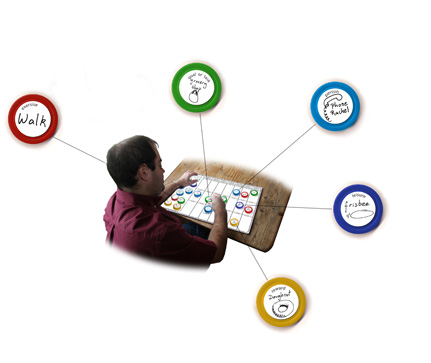
PLANNING HIS WEEK
Peter has plenty of options to choose from. He plans activities for the week ahead, using the magnetic counters, which attach to the board.
TESTIMONIALS
“This modern and re-usable timetabling device will benefit all who need support with structuring their week and implementing motivating goal attainment into their lives. It can be individualized therefore meeting differing literacy, numeracy and cultural needs. It can be utilised as both a diary and reflective piece to measure progress both for everyday living skills and mental health.”
Suzanne Smith- Senior I Occupational Therapist, Therapy and Life Skills Service, City and Hackney Centre for Mental Health
“The 'mind plan' will be a very useful adjunct in developing care plans with patients, it could encourage real improvement in quality of life and it is simple and practical to use.”
Catherine Murgatroyd- Psychiatrist at City and Hackney Centre for Mental Health
“To the best of my knowledge there is no other similar tool as yet. Until now people have used pen and paper to plan their activities. The Mind Plan is more fun to use so is more likely to be used. It is very graphic and activities stand out in a way that is not possible with pen and paper. Activities can easily be moved around which is not so easy with a paper version. I think the strongest point is that it looks fun to use as well as clearly indicating the planned activities.”
John Kentish,
Head of Health Psychology,
Clarence Wing, St. Mary's Hospital
“The planner is a great tool for motivating people on a daily basis.
It provides the user with a flexible structure to work round the routines of meals/medication times. The planner would be very useful as a tool for people leaving hospital and planning days when they get home.
This transitional period is very important in recovery - the planner could be used to ensure basic chores (e.g. shopping, cleaning) get done, as well as making steps back into the world of work, (e.g. voluntary work, visiting libraries) and make people aware of the importance of relationships and leisure activities. The planner could work as a daily reminder of many of the things needed to maintain a strong recovery and good mental health. The planner looks like a very inviting tool to use- it’s design gives it the feel of a 'work-like' (e.g. office planner) object crossing over into the area of a 'fun' (counters) object or 'game'. While the end-goal is some kind of work, the planner allows the individual user to take all the time they need to build up activities, and start at which ever level of daily/weekly activity is most appropriate.”
Worker at Portugal Prints, a mental health rehabilitation workshop managed by Westminster Mind.
MIND - PLAN'S FUTURE
Portugal Prints are currently running a trial of 'Mind - Plan'. Registered design, patent filed
CREDITS
Many thanks to Portugal Prints (part of Westminster Mind) for supporting the project - especially Wendy Bailey and Laura Wilson who work at Portugal Prints and all members of staff.
Many thanks also to Catherine Murgatroyd- Psychiatrist and Suzanne Smith- Senior Occupational Therapist, both at City and Hackney Centre for Mental Health, London.
Many thanks also to John Kentish- Head of Health Psychology
Clarence Wing, St. Mary's Hospital
The award for this competition was sponsored by NESTA.
   

|